
Start with the finished application
Identify the destination market, construction and required test method before comparing flame-retardant polyester fibers. Upholstery and vehicle interiors combine several materials; a fiber demonstration or an LOI value cannot establish compliance of a seat, panel or complete assembly.
Four requirements to review
First, check fire performance and its durability after the specified aging, cleaning or abrasion. Intrinsic modification incorporates the additive into the polymer; a surface treatment follows a different route. Neither description replaces evidence for the proposed grade. Second, evaluate tensile behavior, crimp and compression recovery. Virgin and recycled grades should be judged by the same relevant tests, rather than assuming feedstock alone determines quality.
Color and smoke are separate questions
Third, specify the color reference and required resistance to light and rubbing. Dope dyeing incorporates pigments before spinning, but the actual colorfastness still needs verification. Fourth, request the required smoke and chemical-emission evidence. A recycled-content or skin-contact document does not by itself demonstrate fire performance or low smoke.
How flame-retardant systems can work
Depending on the chemistry, a system may absorb heat during decomposition, promote a protective char layer, dilute combustible gases or change molten-droplet behavior. These mechanisms vary by formulation. Do not assume every FR polyester grade delivers all four effects or never produces flaming droplets.
Compare intrinsic and surface-treated options
Ask both suppliers the same questions: what is the modifier system, how was the sample conditioned, which test was used, what construction was tested and how does performance change after cleaning? Review color, handling, blend compatibility and cost alongside the required test results. The catalog mentioned LOI 26–34% and fire-test references; these are not certified results for every available grade.
Prepare a representative sample
For seating, headliners, public transport, acoustic layers or contract furniture, record all layers and their weights, fiber blends, backing and adhesives. Specify whether the fiber will be carded, needle-punched, spun or used as filling. Produce a representative sample and evaluate it against the applicable acceptance criteria.
Use the demonstration as an illustration
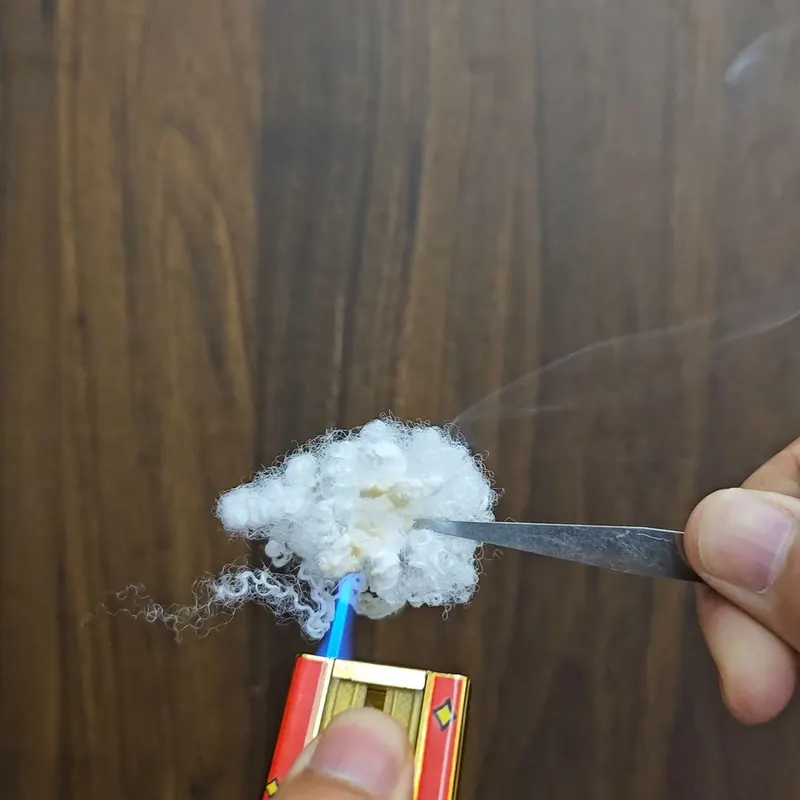
The linked video shows modified and standard PET under a 10-second butane-flame exposure. Observe ignition, dripping and residual char, while recognizing the limits of the demonstration. Request the actual report for the grade and finished construction you intend to buy.
What to send with your inquiry
Include the end use, market, test method, required result, color, linear density, cut length and expected quantity. Attach a technical sheet or describe a reference sample. Hongbo can discuss the listed fiber options and documentation requirements; approval of the finished material depends on the relevant testing.
See the material in use
Material demonstration. Request applicable test evidence for your grade and finished construction.
Watch product video ↗