
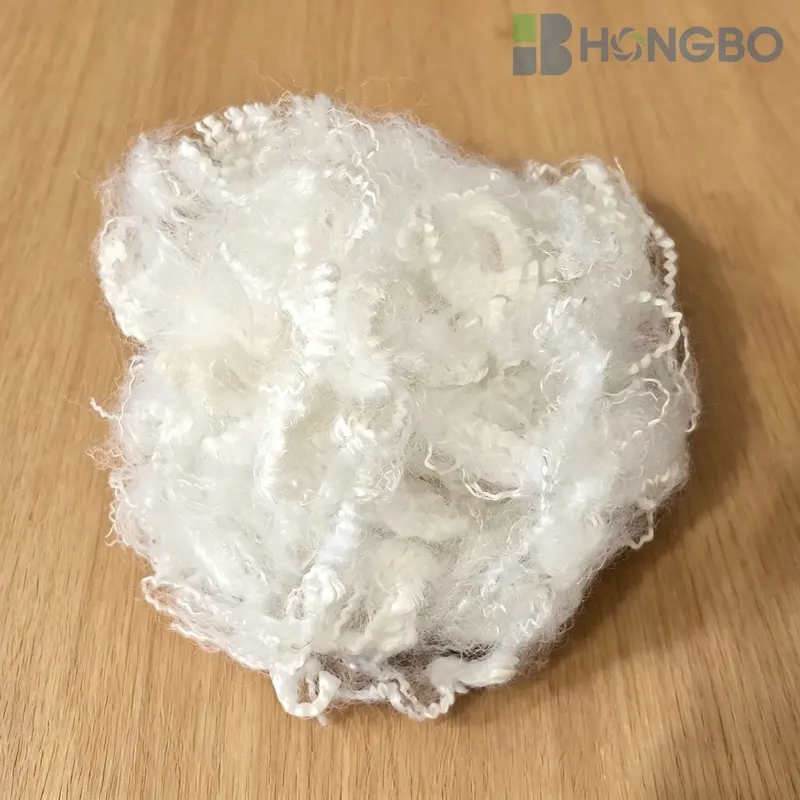
What a low-melt binder fiber does
A lower-melting copolyester sheath surrounds a polyester core. Heating softens the sheath so it forms bonds at fiber intersections; the core helps retain the structure. The result depends on binder percentage, base fibers, web weight, heat transfer and dwell time.
1. Hygiene and personal-care nonwovens
Through-air and calender bonding can create structured webs for hygiene layers and related nonwovens. This guide gives examples of 2.0–4.4 dtex × 38–51 mm, 15–30% binder and 130–140°C. Treat these as trial references, not universal recipes or medical-use approval. Confirm suitability for the intended skin-contact application.
2. Automotive interiors
Potential uses include headliners, pillar trims, door and trunk panels, acoustic layers and seat cores. Base materials may include PET, glass or natural fibers. The original 180–200°C molding example describes a process condition, not the melting point of every binder. Check dimensional stability, bonding and emissions in the complete construction.
3. Filtration
Binder fibers can stabilize contact points in needle-punched or other filter webs, including HVAC, dust collection and liquid filtration. Check porosity, pressure drop, strength and chemical compatibility. Food and beverage contact requires separate qualification; a polyester composition alone is not sufficient.
4. Construction and geotextiles
Possible uses include reinforcement for waterproofing membranes, geotextile felts, mineral-wool systems and composite insulation boards. Evaluate compatibility with the other layers, processing heat, dimensional stability and the actual service environment.
5. Home textiles and furniture
Thermal bonding can stabilize mattress cores, high-loft wadding, bedding layers and carpet backings. Choose between softness and rigidity through the blend and process. Reducing liquid adhesive use does not automatically establish zero emissions, wash durability or a formaldehyde-free finished product.
6. Specialty paper and synthetic leather
This guide describes 3–6 mm short-cut fibers for pulp reinforcement and binder use in synthetic-leather base fabrics. Wet strength, tear behavior and interlayer bonding depend on the formulation. Tea or coffee filters and battery separators require their own application-specific testing.
7. Apparel and footwear
Interlinings, collars, shoe components and insulating wadding can use heat-bonded structures. Check drape, stiffness, laundering and fiber migration in the finished article. The binder grade and cut length must fit the relevant textile process.
8. Other technical uses
Further potential applications include heat-sealable cable tapes and matrix structures for abrasive or polishing products. Specify the operating conditions, mechanical requirements and compatibility with the other materials before selecting a binder.
Choose a melting range, then validate the process
This guide groups examples as low 110–120°C, medium 130–140°C and high 170–180°C. These categories do not imply that all grades are currently offered. Match the confirmed grade to through-air bonding, calendering or oven-and-press processing. Start with the thermal profile, then validate time, temperature, blend ratio, strength and loft on your own line.